The true origin of Table Tennis is largely unknown, although forms of the sport have been documented as early as the late 1800s in England. The sport started becoming popular around the world in the early 1900s. During this time, the official name of the sport was changed from Ping-Pong™ to table tennis. This was due to copyright conflicts with Parker Brothers, who owned the rights to the name and game of Ping-Pong™.
The International Table Tennis Federation and United States Table Tennis Association(later changed to United States Association of Table Tennis) were formed at about this time. These organizations would go on to become the primary ruling bodies of table tennis.
Table tennis has evolved significantly since its surprise birth upon the sporting world, acquiring many revisions of rules and seeing an evolution of equipment as technology and playing styles changed. Such refinement only serves as evidence that table tennis is indeed a full-fledged sport, comparable to any of the other classics we behold with reverence.
Many people know Table Tennis as Ping Pong. It's the game that is usually played in the basement with an opponent, with plastic paddles in hand that made the distinctive noises when a ball was struck. A fun game it was, sort of like playing T-ball with huge yellow plastic bats or nerf football. But like those two familiar games, ping-pong also has a real sport behind it.
Table Tennis can be classified as a major sport worldwide, with millions of participants, major tournaments(with its own superstars), and many other things that make a sport truly a class of its own.
As a sport that emphasizes endurance and reflexes above simple size and strength, people of all ages and genders can play on an equal field. The equipment can be had for a reasonable price, and the sport is played indoors so year-round competition and practice is possible. A game requires only two players at the least, and typically lasts around 30 minutes, enabling quick matches during breaks, etc.
Techniques:
Within are most of the basic preparations and strokes necessary to get you started. A few of the more advanced techniques are also discussed. One may wish to move from top to bottom-from most basic to more advanced, but don't hesitate to look ahead to get a taste of what's to come.
There is no written substitute for live instruction, so if you are lucky enough to have access to a club or a skilled acquaintance, then be sure to spend as much time training with them as possible. Even if such opportunities are hard to come by, we strongly suggest that you see a skilled instructor or practice partner as soon as you can. A few meetings are better than nothing at all. This is critical when you are just beginning to develop your game, since you will be getting off on the best table-tennis foot.
Above all, practice these techniques constantly! Just like any other sport, Table Tennis demands the utmost in effort from the prospective player. Various practice techniques are discussed, whether with a partner or alone. Obtaining a regular practice partner early in the game is a very good way to get better steadily.
Table Tennis Facts
- ...the current superpowers(1998) of international table tennis include Sweden, China, Germany, Belgium, and South Korea.
- ...back in the days of unregulated rackets, all sorts of strange materials were at the tables. Among the stranger ones include: 5 inch think sponge, pure wood, and sandpaper.
- ...the name ping-pong is trademarked by Parker Brothers, who wanted a huge sum of money from USATT for the rights to that name. In response, the community gave the sport its own name: table tennis.
- ...the name of the United States of America Table Tennis used to be United States Table Tennis Association.
- ...certain world-class players can put up to 9000rpm of spin on table tennis balls.
- ...table tennis balls aren't really hollow. They are pressurized slightly with a gas.
- ...more than 30 table tennis companies exist around the world, making a full line of accessories from paddles to warm-up suits.
- ...in Europe and Asia, table tennis is big business and is very popular overall. Top players are endorsed just like players are endorsed in USA by shoe and apparel companies.
- ...certain governments(like Sweden and China), actually pay their top players just to practice.
- ...in China, most children are evaluated for certain inherent talents early on. If they are found to be particularly proficient at something, like gymnastics or table tennis, they receive rigorous training in that area.
Table Tennis Terms
- Anti-topspin - a rubber type that deactivates spin and speed, returning a "dead" ball
- Backhand - a stroke done directly in front of the body, with the racket turned so that the back of the hand faces the opponent
- Backspin - a type of spin where, if struck with a normal racket position, the ball would not make it over the net
- Block - a defensive shot done mostly against loops and smashes, where the racket is in a closed position to keep the ball on the table
- Chop - a defensive shot that carries a tremendous amount of backspin
- Closed - a racket angle that allows the top of the ball to be struck
- Dead ball - a ball returned without any spin. Very difficult to execute, read, and return
- Doubles - a format in table tennis where two people play on each side and must alternate turns at striking the ball
- Drive - an offensive shot used mostly as a setup or in rallies, where the racket is in a normal position and the ball is struck at a medium pace
- Drop shot - a surprise shot where the ball is placed precisely near the net
- Expedite rule - after a time limit (10 minutes) has expired during a single game, the receiver automatically wins the point if he/she returns the ball successfully 13 times in a row. This forces the server to change his rallying tactics.
- Forehand - a stroke done to the right-front (for right-handers) of the body, with the racket in a normal position (palm of hand facing opponent)
- International Table Tennis Federation - the international governing body for the sport of table tennis
- Inverted - See pips-in
- Let - a stoppage of play as a result of a serve hitting the net or interference from outside the playing court
- Lob - a defensive shot used against high-speed balls, where the ball (usually with unpredictable spin) is returned very high in the air, causing difficulty in timing and technique
- Long pips - a rubber type whose surface consists of fairly long pimples. Produces unpredictable spin.
- Loop - an offensive shot that carries a tremendous amount of topspin
- Match - a competition format with the winner winning two of three or three of five games
- Medium-long - a serve whose second bounce, given the opportunity, would bounce near the very end or just off the table. Difficult because the opponent cannot execute a good attacking stroke
- Open - a racket angle that allows the bottom of the ball to be struck
- Penhold - a grip where the racket is held exactly as it sounds, with the racket handle held straight up and down
- Pips-in - a rubber type whose surface is smooth yet gripping. Produces much spin and in many cases better speed. Also known as inverted rubber
- Pips-out - a rubber type whose surface consists of many tiny pimples. Produces much control and speed, but little spin
- Push - a defensive shot used to successfully return backspin shots, where the racket is open to lift the backspin over the net
- Receive - return of service, usually done tactically to set up an attack
- Seemiller - Name of 5 time US champion Dan Seemiller. Also the name of a table tennis grip
- Serve - the beginning of a point where one player strikes the ball after tossing it. Usually used tactically to set up a strong attack
- Set - one game to 21 points in a match
- Shakehands - a grip where the racket is held exactly as it sounds but with the middle, ring, and pinky fingers wrapped around the handle
- Short - a serve that, given the opportunity, would bounce at least twice on the table. Difficult because the opponent cannot execute a good attacking stroke
- Sidespin - a type of spin where, if struck with a normal racket position, the ball would travel either to the right or left without landing on the table
- Skunk - an informal rule in table tennis that says that a player wins a game at a score of 7-0 or 11-1
- Smash - an offensive, high-speed shot used against high balls, where the racket is in a normal position to generate the most speed possible. Also called a kill
- Topspin - a type of spin where, if struck with a normal racket position, the ball would travel over the opposite side of the table without hitting the surface
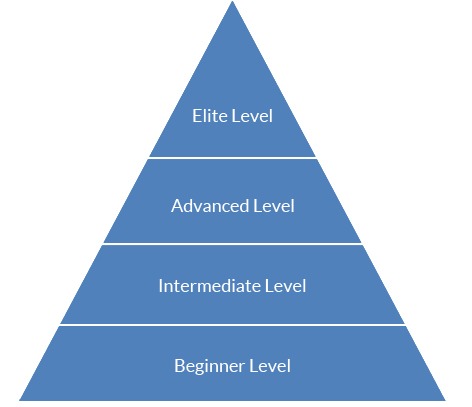
In each coaching session, players may be organized into small groups based on their current ability, allowing flexibility to meet the needs of the players attending the session on any given day. Some players will progress very quickly from Beginner to Novice and some may need more time to master certain basic skills. The individuals' needs are always kept in mind as a coach adapts the instruction.
The Beginner level curriculum focuses on introducing and strengthening fundamental stroke, footwork and coordination skills that build the foundation needed to introduce basic tactical and strategic play. With instruction and drills that are adapted to meet the fitness level of the individual (low impact to highly athletic), each player progresses not only in skill, but also in whole body motor skills, coordination, and fitness.
As players move from Beginner to Novice level, they will continue to develop fundamental skills, building a larger arsenal of basic strokes and spins. At the Novice level, players are introduced to tactics and strategies, and improving players will begin to take their play from reactionary to mindful. Players will be challenged to use their stroke and body coordination more effectively, allowing more time (although just fractions of seconds) to react strategically so they can determine and manipulate subsequent reactions of their opponent.
Beginner Table Tennis skills include but are not limited to:
- Learning different grips and how to properly hold the racquet.
- Developing contact with the ball and racquet on a consistent basis.
- Learning how to execute basic serves, strokes, footwork.
- Learning how to hit the ball back and forth at least three consecutive times in one area of the court (for example, to the opponent's forehand court).
Novice Table Tennis skills include but are not limited to:
- Learning how to do multiple types of serves.
- Learning how to do a correct forehand stroke
- Learning how to do a correct backhand stroke.
- Developing contact skills (forehand and backhand) to do repetitions of at least 10 in each court.
- Improving serves and developing more complex serves.
- Developing a basic understanding and familiarity with chops, pushes, blocks, and counter drives.
- Understanding court and match rules.
Intermediate level are scheduled to meet at the same time but will be instructed in appropriate small groups based on age and ability.
While continuing to reinforce competence in basic skills, instructors will introduce new techniques, building higher levels of competency regarding shot placement, stroke technique, complexity of serve and serve return, strategic play analysis, and confidence and sportsmanship both on and off the court. Players will work on their ability to perform in a match play scenario.
This group session will target fitness, endurance, mental focus, footwork, coordination skills, efficient and effective body movement, and repetitive shot precision placement. Drills will become a major part of this training, and may include robot training. Additionally, instructors will emphasize understanding when to attack the ball; identifying weaknesses in the opponent; and executing 3rd ball and 5th ball attacks. Finally, players will be introduced to playing against opponents that use different types of rubber, including short pips, medium pips, long pips, anti-spin rubber, etc. Players will practice and gain competence in countering alternative types of rubber they may typically encounter in matches.
Skills include introduction and initial development of:
- Blocking to both courts
- Targeting opponent's forehand court and backhand court
- Forehand and backhand pushing
- Forehand drives to opponent's forehand court
- Backhand drives to opponent's backhand court
- Forehand and backhand chops
- Forehand and backhand looping
- Different types of serves, including: underspin, topspin, sidespin, corkscrew, and deadball
- Blocking to both courts
- Targeting opponent's forehand court and backhand court
- Forehand and backhand pushing to opponent's targeted forehand or backhand court
- Forehand drives to opponent's forehand court
- Backhand drives to opponent's backhand court
- Forehand and backhand chops to either of the opponent's courts
- Forehand and backhand looping to either of the opponent's courts
- Different types of serves to the opponent's forehand and backhand courts, including: underspin, topspin, sidespin, corkscrew, and deadball.
This curriculum focuses on consistently performing skills learned in previous curriculums, as well as on developing new skills. Players will benefit from many drills and multi-ball training sessions with advanced level sparring partners. Emphasis for this level includes advanced level techniques, greater consistency, greater accuracy, ability to analyze an opponent's strengths and weaknesses, strategy, and superior game knowledge.
Coaches will mentor the development of each player's confidence, promoting excellence with sportsmanlike demeanor and positive attitude. This level of Group Instruction also focuses on the individual's ability to adapt to intense situations, challenges and physical/mental demands on and off the court. This enables the player to perform and achieve superior results, and brings out his or her best in tournament match play – regionally, nationally and internationally.
Skills include but are not limited to:
- High performance forehand looping and backhand looping
- Multiple loops in repetition (forehand and backhand alternating)
- Precision shot selection and placement: both left versus right, and short over the net versus deep towards the end line
- Consistent performance of many drills, including: cross court to down the line drills, forehand and backhand drills, and counter drive loop drills, and looping of under-spin serves.
- Consistent execution of the slow backhand push, fast backhand push-block; slow forehand (topspin) roll/flip, fast forehand topspin loop; slow controlled (spinny) topspin loop
- Strategic use of speed versus spin while looping
- Consistent performance of complex service variations, including short-touch services (forehand and backhand), long top spin services (forehand and backhand), etc.
- Proper return of serve from a half-volley
Strategic sequencing of strokes, including:
- Combining topspin and underspin strokes
- Combining drives and pushing
- Combining (underspin) defensive returns with push, topspin, topspin forehand and backhand drives
- Combining both counter-driving close to the table and distant (back) from the table
- Combining forehand and backhand defensive backspin returns
- Sequences of topspin and backspin strokes, such as loop-topspin forehand, loop topspin backhand, loop underspin forehand, and loop underspin backhand – close to the table and back away from the table
- Short over the net flipping techniques
- Mid-rally sidespin/topspin blocking techniques
- Ability to maintain intensity during an attacking rally
- Mastery of stamina and focus
- Overall sustained endurance throughout matches and tournaments.
The Elite level training curriculum is developed and implemented by elite coaches and athletes, working in collaboration to master high performance and endurance at an international competition level
Coaches will mentor the development of each player's confidence, promoting excellence with sportsmanlike demeanor and positive attitude. This level of Group Instruction also focuses on the individual's ability to adapt to intense situations, challenges and physical/mental demands on and off the court. This enables the player to perform and achieve superior results, and brings out his or her best in tournament match play – regionally, nationally and internationally.
Skills include but are not limited to:
- High performance forehand looping and backhand looping
- Multiple loops in repetition (forehand and backhand alternating)
- Precision shot selection and placement: both left versus right, and short over the net versus deep towards the end line
- Consistent performance of many drills, including: cross court to down the line drills, forehand and backhand drills, and counter drive loop drills, and looping of under-spin serves.
- Consistent execution of the slow backhand push, fast backhand push-block; slow forehand (topspin) roll/flip, fast forehand topspin loop; slow controlled (spinny) topspin loop
- Strategic use of speed versus spin while looping
- Consistent performance of complex service variations, including short-touch services (forehand and backhand), long top spin services (forehand and backhand), etc.
- Proper return of serve from a half-volley
Strategic sequencing of strokes, including:
- Combining topspin and underspin strokes
- Combining drives and pushing
- Combining (underspin) defensive returns with push, topspin, topspin forehand and backhand drives
- Combining both counter-driving close to the table and distant (back) from the table
- Combining forehand and backhand defensive backspin returns
- Sequences of topspin and backspin strokes, such as loop-topspin forehand, loop topspin backhand, loop underspin forehand, and loop underspin backhand – close to the table and back away from the table
- Short over the net flipping techniques
- Mid-rally sidespin/topspin blocking techniques
- Ability to maintain intensity during an attacking rally
- Mastery of stamina and focus
- Overall sustained endurance throughout matches and tournaments.
If you are interested in joining us, come on over to our club and see us. Then you can decide whether this is the club for you. Please let us be clear, you do not need to join the club immediately as we would also like some time to know you better. Join only when you feel comfortable that you will have an enjoyable time here with us. We would encourage you to contact us before you come.
Kindly fill up registration from, bring your Passport copy with Visa page, Emirates ID Card copy and one recent passport size photo.
You can reach us by calling 055 2007182 or connect with us through our Face Book Page: Prime Star Sports Services. If you like to keep updated with our latest news and events, do "like" us on our Facebook page.
Prime Star Sports Services strives to provide quality Table Tennis training for all trainees. The coaches in our academy are equipped with high quality knowledge and place our trainee's interest as the priority during every training session.
Every coach ofour academy is open to any kind of feedback from the trainees to constantly upgrade themselves by learning and increasing the variations of the drills provided to the trainees. This ensures that training is not monotonous and repetitive.
The group-training fee is AED 400 Per Month for 8 Session, inclusive of table fees.
Beginners training session 1 hour
Intermediate training session 1 hour 30 minutes
Advance training session 2 minutes
Elite training session 2 hour
Yes we do provide training for Adults
We do run a table tennis class for children every day in different locations, 4.00 PM to 5.30 PM and 5.30 PM to 7 PM. It is meant for children at beginners level, intermediate level and advance level to learn Table Tennis.
Yes, we have several regular female players.
Yes! We strictly do not tolerate any swearing or the use of foul language or bad sportsmanship during the games. You will be asked to leave the club for repeated offenses.
Additionally, we always encourage our players on court to exchange handshake after completing a game.
If you have not played badminton before then wear sports kit that will allow you to move freely. It's a fast game requiring quick movement around the court, kindly use Non-marking shoes.
The session will usually last for one and half hour.
We are more than happy for them to be left in our care, as we have not much space to accommodate parent in training place.
You will need to bring enough water, proper non-marking shoes with you and a Table Tennisbat.
This will depend whether your child is a beginner or more experienced. Basics will include correct grip, different Table Tennis shots and techniques in efficient movement around the Table.
Even experienced players find the lessons very useful. Helping them to target areas they wish to improve on, through repetitive practice. More advanced skill levels and techniques can be introduced, such as mental attitude, tactics and deception.
Once you proceed onto Table Tennis court you will be greeted by our instructors/Coaches. Just let them know you are new and they will have you on their registers. The children will meet their instructor/coach, who will then assess their playing ability throughout the lesson to ensure that they are in the right class.
The first couple of sessions are all about getting your child comfortable with the academy, meeting the other children and getting them excited for the journey ahead.
Each Beginners lesson will be structured so that it is productive and fun for your child, regardless of what ability level they are at.
Children will be warmed up for the first 10 minutes of their lesson, followed by a 20 minutes focus on key technical skills, a 20 minutes fun activity, and a 10 minutes cool down at the end.
Instructors will monitor your child and decide whether they need to move classes. If you feel like your child is progressing at a faster rate than some children, please chat to our admin team they will arrange a meeting with coach/teacher/instructor.
Kindly meet the admin team in the respective location, please feel free to raise any issues that you may have with them. The administrator will then feed these back to the instructor/coach.
We request the parents don't disturb the instructors/coach. We like their time to focus solely on teaching the children.
Alternatively, please email us at info@primestaruae.com or call us on 055 2007182 to speak to your Manager.
Yes. It is all-inclusive price.
The maximum number of trainees in each training group is 6 for each Table.
Prime Star Sports Services provides training at a few locations, mainly: India Academy School and Ahmed Bin Rashid School. To know more about the location, please refer to "contact us" in the webpage we have location map.
The rates are not negotiable.
For group training, credits will only be carried forward to the next month if there is an advance notice of at least 48 hours or if a copy of a medical certificate is produced within the next 12 hours after the training has started. Any last minute changes within 48 hours before the training commerce, without proper medical certification, will result in the deduction of credit as though he/she has attended the training. No refunds would be given for that session.
If a planned session is cancelled by the academy, then our main priority is to re-schedule the session.
If it is not possible to do so, we can transfer the lesson fee as a credit to the following term.
Classes depend on ability. Come to our center our coaches will take the assessment and advise on the right level.
Can be paid for by cash and any major credit or debit card.
Yes, Yes cash and Cards are accepted at the centers. Please ensure that you pay before the lesson.
Cut the rubbers precisely, exact to the contour of the blade and put a protective tape around the blade because if you re-glue your racket a lot, you will notice that the rubber will be stretched.
The problem you have is possibly due to the glue you use. Try to glue the rubber twice. Let the first layer of glue dry on your blade, and put the same amount of glue on both the rubber and blade for the second layer of glue.
In singles, the player can serve wherever he wants (not only diagonally) from whichever side he prefers.
Lets say you are playing doubles and you have players A, B, C, and D. The game starts with player A serving five serves and player C receiving. Then player C serves five serves and B receives. Then player B serves five serves and D receives. Then player D serves five serves and A receives (fig. 4) Then player A serves five serves and C receives. And the circle is repeated. The serve is executed always diagonally and only from the right side.
The ball has to bounce first on your side and then to your opponent side.
The rule is that when you do a serve fault, you lose the point.
There are a lot of rackets for beginners as well as for medium experienced players. Try to define your playing style and choose the appropriate combination of rubbers and blade.
The server gets the point.
You arrange the server or the receiver at the beginning of the match telling it to the referee.
It doesn't matter if the ball passes around the net.
No, it's not legal. You lose the point.
The white lines are in play.
The player who hit the ball gets the point.
Yes, the ball has to be tossed about 15 cm high.
The ball can pass over the net or outside the net. Both are legal.
He loses the point.
Yes, the ball must bounce once before you can hit it.
A coin toss determines who serves first. The winner of the coin toss chooses the serve or the side.
- When the server fails to make a good serve.
- When the receiver fails to make a good return.
- When you hit the ball, it doesn't land on the table or it goes to the net.
- When you touch the table with the free hand during the rally.
- When you touch the net with any body part during the rally.
- When you moves the playing surface during the rally.
- When you hit the ball twice successively.
- When the ball bounces twice successively in your side.
- If, in doubles, the player who hit the ball is out of sequence.
- When you hit the ball before it has bounced on your side.
If your racquet accidently touches the ball that passed over the table, you win the point.
 Testimonials
 Hriday, my 11 year old; has been a swimmer since he was 4, and has been training at Prime Star Sports Services for a little over a year now. Along the way both he and my younger son took up Badminton as well. I think there can be no better testimonial than the simple fact that both my children are happy and feel that they belong with Prime Star. They train for long hours without cribbing, and never do I have to nudge them to go for training. That speaks volumes about how comfortable, secure and welcome they feel at the academy. As a parent, I like the warmth at the Academy and have seen my children grow and improve in their sport. Like any other place, there are areas they can improve and am sure as they grow, they will. Here's wishing the Prime Star team all the very best!
 "Primestar is a fabulous sports academy ,where kids are trained to become true champions with the right spirit of life, moreover club has a great family atmosphere synchronized by coaches , parents and the management . We feel proud to be part of the prime star family "
 Student Name: Aaryan Sriram | Activity : Swimmimg | Location : Egyptian Club Commitment and focus leads to success' is something we have all heard but as part of the Prime Star family my child experienced how the commitment and focus of others can lead to ones success....Having trained with Head coach Fransir Sir since the age of 7, my son Aaryan learnt what dedication and single focussed pursuit of excellence can do. His time with Prime Star taught him that success is a by product when you are true to your passion. For Aaryan, his coaches are his friendsnd the swimming pool is his playground.
  My twins Aradiita Sunder Iyer and Adwaita Sunder iyer (age 13) have been swimming for nearly four years and have participated and won medals at several competitions··including some prestigious ones like CBSE national India ,Open national India,Emirates cup etc···their medal count touching a hundred or more. They have been trained and nurtured by head coach Francis, and are one of the first members of the primestar family. FAMILY it is indeed, where there is trust , faith ,compassion and care.